Total votes
5-11 votes
11-16+ votes
With the first trial launched in 2020, e-scooters have become an increasingly recognisable sight in our town centres. Yet they are not without their critics and have been a continual source of confusion for both legislators and the public. Currently classed as motor vehicles, e-scooters are illegal to ride in the UK outside of one of government-approved rental schemes. Popular as a budget and eco-friendly option for short journeys, you must currently have a driving license (full or provisional) to rent an e-scooter with a limit to one user at a time and helmet use encouraged. Critics say these safeguards are not enough with 2,390 casualties involving e-scooters in 2024, including 6 deaths recorded. Other major European cities have abolished their e-scooters schemes due to a rise in accidents. The UK government has yet to make a final decision. What do young people think? A fun and eco-friendly way to get around? Or more accidents waiting to happen?
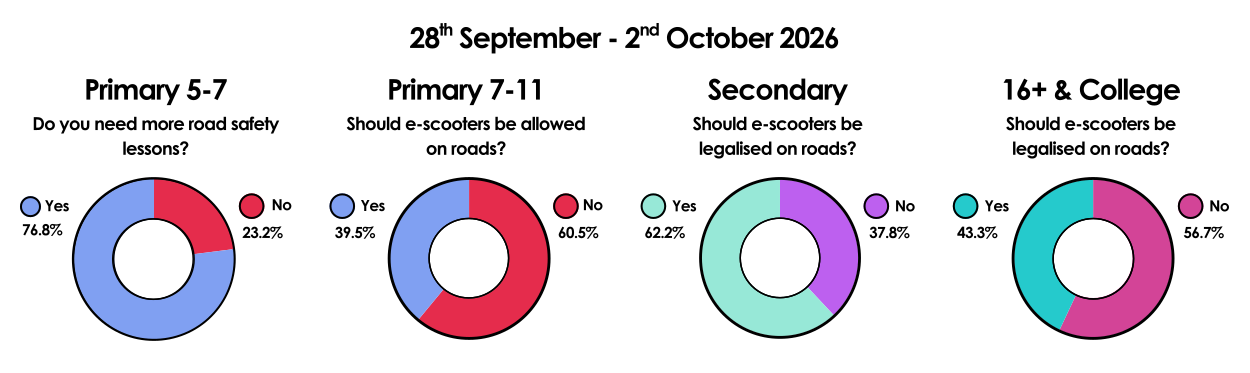
Primary 5-9 were asked, "Do you need more road safety lessons?"
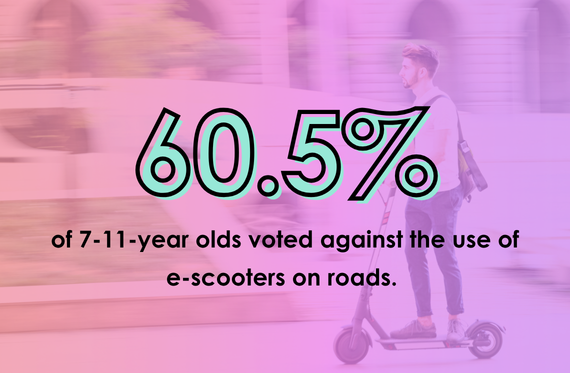
Primary 9-11 voters discussed, "Should e-scooters be allowed on roads?"
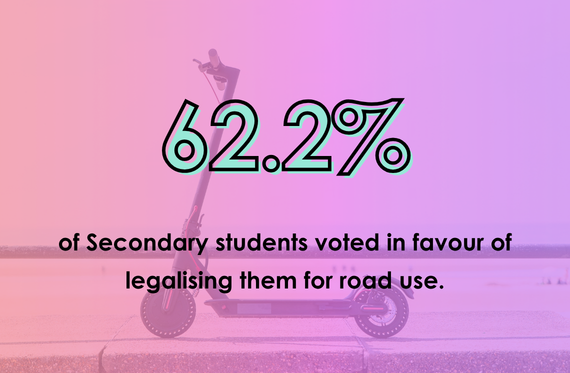
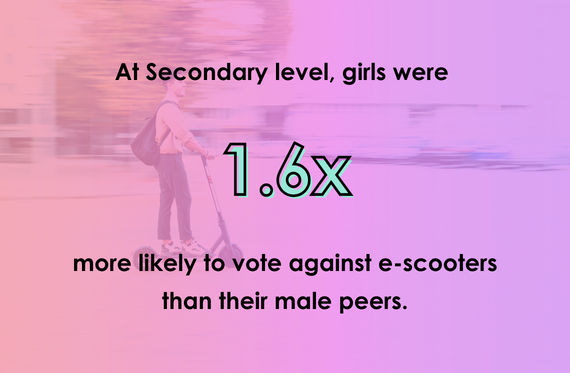
Secondary and 16+ & College debated, "Should e-scooters be legalised on roads?"
65,944 young people participated in these votes will many more joining dicsussions in their schools and classrooms.

No... there should be tighter controls for the people selling the scooters. they should be banned from being sold.

It is too dangerous to be legalised. They are already causing accidents so if it is legalised it will only cause more accidents.

We voted 'yes' however, there should be restrictions on the legalisation such as you must wear a helmet, not be on pavements and using bike lanes, speed restrictions.
Thank you to Road Safety GB, and Katrina Phillips OBE, Chief Executive of the Child Accident Prevention Trust for responding to young people's votes!

"It's great to see how important safety on our roads is to you and how keen you are to learn more.
You picked up on all the good and bad things about e-scooters. On the plus side, they’re quicker than walking and can be better for the environment. But you also understood the dangers, particularly falling off with no helmet.
Lots of you felt that – if e-scooters are allowed on our roads – there need to be rules around safety.
Here at the Child Accident Prevention Trust, we want to get the balance right too. Your well-thought-out views were so helpful for us to hear."
Katrina Phillips OBE, Chief Executive of the Child Accident Prevention Trust
Primary 5-7:
"Thank you so much for voting about road safety! It’s great to hear that lots of children aged 5 to 7 would like more road safety lessons. You’re right – road safety is an important life skill. We all need to learn how to stay safe near roads and keep practising as we grow up.
There are lots of people who can help us learn about road safety. Road Safety GB has members across the country who provide resources and support for children, teachers and families.
There are also some brilliant online resources, such as THINK! with fun activities and information for children and teachers.
Remember: learning about road safety helps us make safer choices every day!"
Primary 7 -11 and Secondary, 16+ & College:
"Thank you so much for your vote! Road safety GB can understand why many secondary school pupils support being able to ride an e-scooter. Unfortunately, it remains against the law for any person under 16 to ride a scooter in a public place.
Survey responses recognised that e-scooters are environmentally friendly, fun and cheap but also that riders are vulnerable if they don’t wear helmets and aren’t seen by cars, and that riders can be a danger to people on pavements.
E-scooters need to be regulated so that riders can be sure they are buying a safe machine, but we must also consider how we make riders visible and update the Highway Code to keep everyone safe.
Road safety GB asks you to keep yourself and your friends safe on the roads by not riding or being a passenger on an e-scooter."